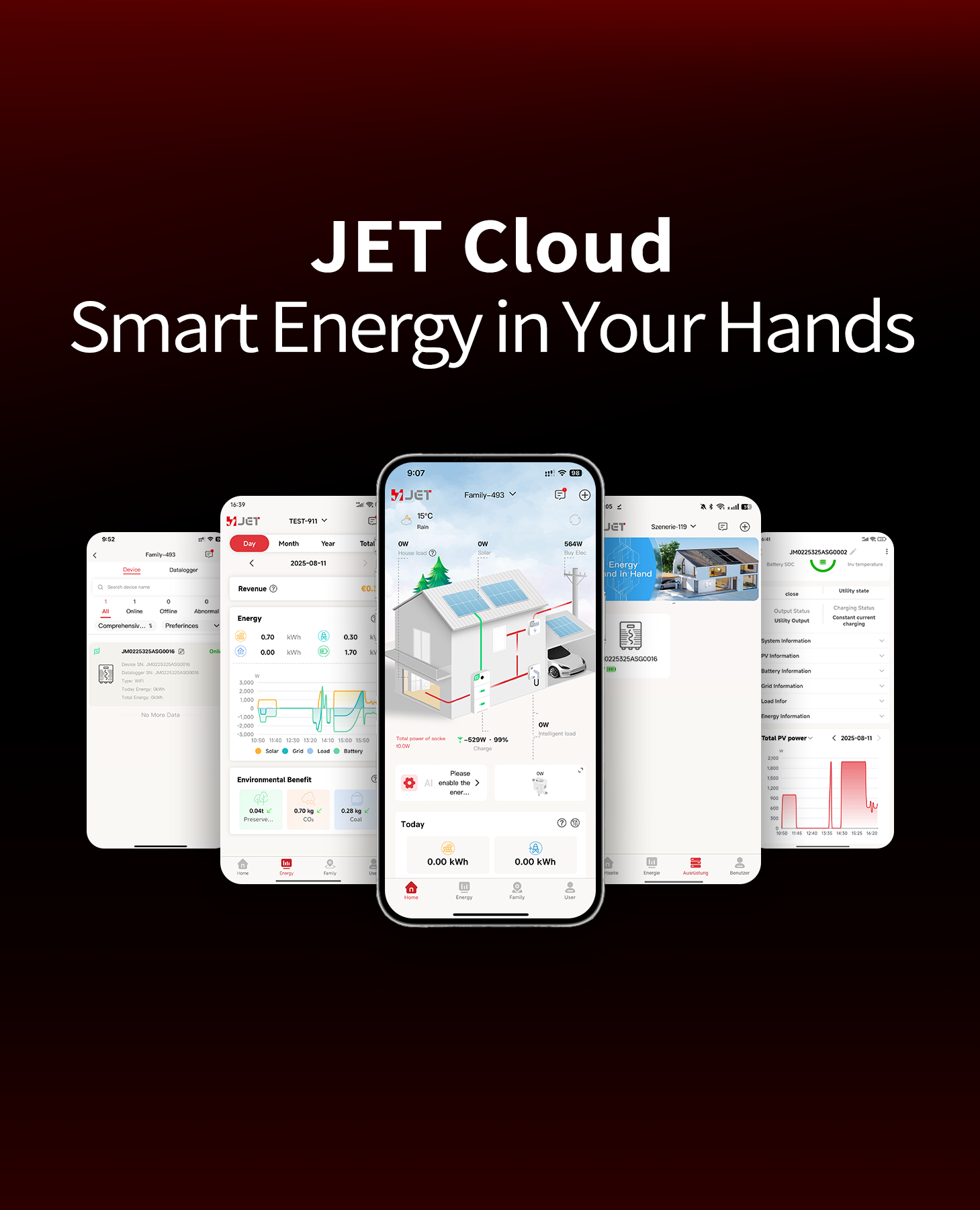
JET Cloud: A Smart Breakthrough Against Rising Electricity Bills


According to data from Fraunhofer ISE, Germany’s solar self-consumption rate has shown a steady and moderate increase in recent years. This indicates that more households and businesses are reducing their reliance on the public grid by installing photovoltaic (PV) systems.
However, a puzzling reality remains: even with solar systems installed, many users still face considerable electricity bills. This phenomenon has sparked widespread discussion within the energy sector.
The Hidden Contradictions Behind Rising Solar Self-Consumption
As a global leader in solar adoption, Germany has seen continuous growth in residential PV installations over the past decade. In theory, solar panels generate electricity during daylight hours for direct household use, with excess power either stored or fed back into the grid—significantly lowering electricity costs.
In practice, the situation is far more complex:
Day–night and seasonal imbalance: Solar power is generated only during the day, while households still rely on the grid at night
High weather dependency: Power generation drops sharply during cloudy or rainy conditions
High storage system costs: Advanced battery systems remain expensive, and many households do not install them
Fixed grid charges: Even with reduced consumption, grid connection and maintenance fees still apply
Unoptimized consumption habits: Peak solar generation does not always align with peak household demand
How Does JET Cloud Minimize Your Electricity Bill?
1. PV-First Energy Dispatch
The system always prioritizes clean solar power generated on-site, dynamically matching production with household demand. This maximizes self-consumption and reduces reliance on grid electricity at the source.
2. Off-Grid Backup & Peak–Valley Arbitrage
JET Cloud intelligently manages battery storage—charging during periods of low electricity prices or excess solar generation, and discharging during peak-price hours or at night. This ensures uninterrupted power for critical loads while enabling effective “charge low, discharge high” cost optimization.
3. AI-Driven Dynamic Tariff Response
Powered by AI algorithms, the system learns and predicts electricity price fluctuations. It automatically reduces grid consumption during peak pricing periods and increases usage during rare negative pricing events—turning electricity costs into potential gains.
4. Intelligent Anti-Feed-In Control
Through precise power regulation, the system ensures solar energy is consumed locally whenever possible, preventing excess power from being fed back to the grid at unfavorable rates. This protects investment returns and maximizes the value of every kilowatt-hour generated.
5. Scalable Multi-Unit Power for High-Demand Scenarios
The system supports flexible expansion, enabling intelligent coordination of multiple inverters and battery units. This meets high-power demands such as EV fast charging and full-home electrification—without compromising overall energy efficiency or cost control.
In the future energy landscape, “how much you generate” and “how smartly you consume” will be equally important. The experience of German solar users makes one thing clear: Installing solar power is only the first step toward energy independence. Intelligent energy management is the key to achieving real economic and environmental benefits.